
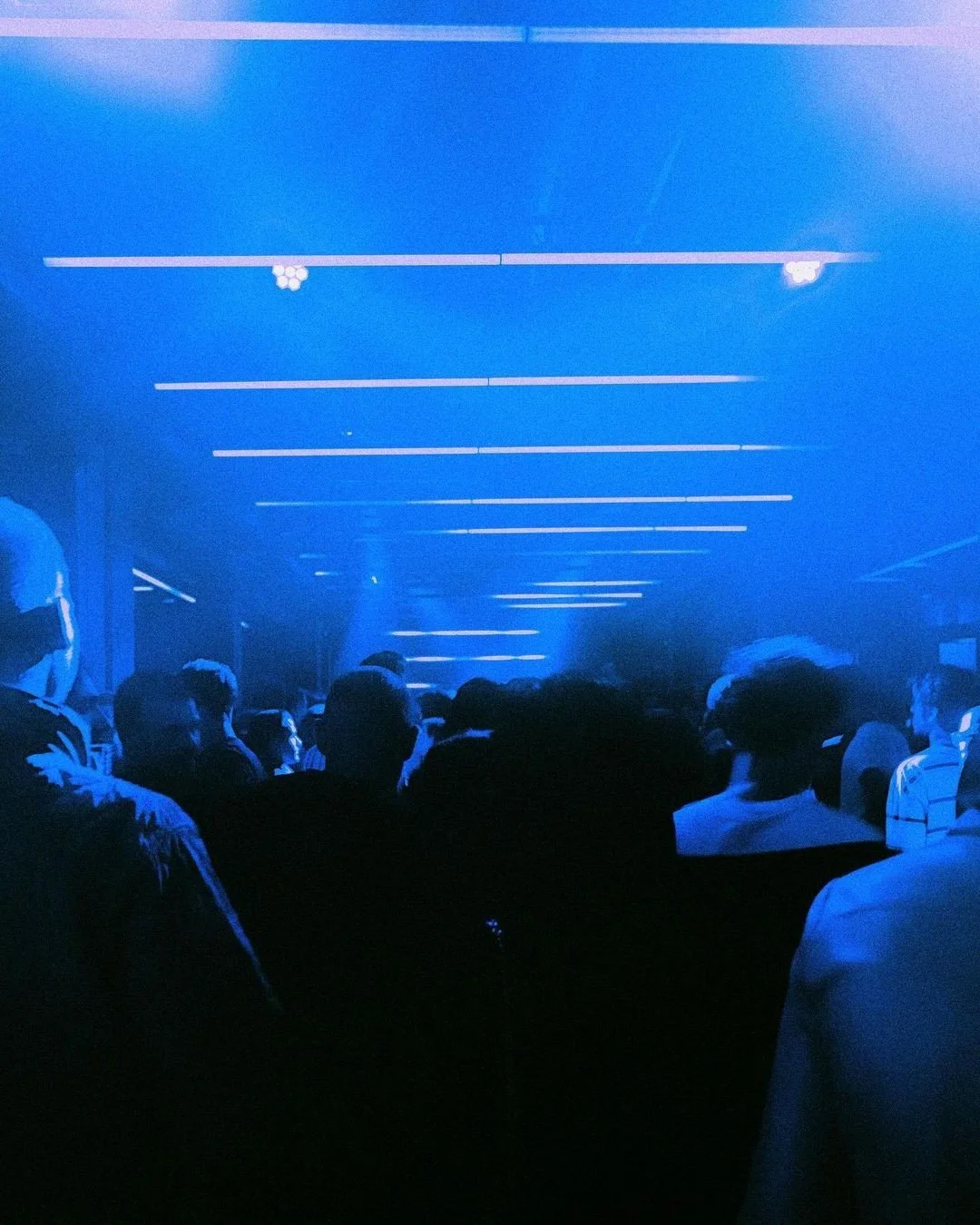
rave
Methods
6 weeks, July 7 - August 11
tuesdays, 7PM EST
A SOFT OPENING, BUSHWICK
How does one rave? This is a class on methods (what are we doing and how do we do it, better) rigorously applying contemporary approaches in aesthetic theory to switch up the game, redefine the coordinates, make it new. From Continental philosophy to queer psychoanalysis, theory can be a new way of articulating ways we have already been raving, but open up radical possibilities of confrontational leisure, strategic resistance, and collective transformation.
Rather than learn how to write or think about the rave, this class explores how to rave in practice. Mixing lecture and deep conversation, we welcome nightlife workers and producers, and anyone who’s tired of raving on autopilot (or if you just want to understand nightlife with a critical lens and meet the weirdos who would sign up for this kind of thing).
Class
Structure
Each week will feature one or a few essays across critical traditions. Seminar will break down the concepts from the reading in plain language and a cute slideshow (even if you didn’t finish the reading, the seminar will catch you up on all that). Then we’ll discuss what we got out of the reading. We hope to put old arguments to rest—-”Should I do drugs even if they’re bad?” “Does techno belong to Black or queer people?”—-and think-tank about how we can apply these new methodologies to our own practices and lives.
facilitators
GEOFFREY MAK co-edited Writing on Raving with Zoë Beery and McKenzie Wark, an anthology from a reading series of the same name on nightlife writing. He is the author of Mean Boys.
CHRIS SHULTZ is a bookseller, archivist, and DJ who studied philosophy of aesthetics. He is part of the collective that throws Fiber, an NYC party that provides nourishment through good food and experimental music
Syllabus
Week 1: the rave as BODY POLITIC
The rave isn’t inherently political, but it is always politicized. The rave might not have a political purpose, but it will be used for political purposes. So should we just be more conscious of using it for politics? IMMANUEL KANT would say no. That art and beauty, including dance music or the rave itself, are purposeless give it a “freedom” that Kant said reflected the essence of the human spirit. We rave to be human. And it’s our humanity around which liberal democracy and human rights are formed. Can the rave can be the very thing that constitutes the body politic? Let’s break down how that works and why and where that can be applied practically.
Week 2: THE RAVE AS AVANT-GARDE
What is the avant-garde? It is the quality of an artwork to test the language of a medium in various ways to expose the medium and determine what it can express. Launching from 18th century philosophy of the sublime, JEAN-FRANCOIS LYOTARD outlines three criteria of the avant-garde. The first is its capacity for metacognition: a medium contemplating itself. The second is to express the ineffable. The third (his unique addition) is a representation of nothingness, which can’t be represented. Through techno criticism from KODWO ESHUN and DESTINY B.E., we examine techno’s ability, or failure, to meet these three criteria, and discuss what these unique problematics mean for raving today.
Week 3: THE RAVE AS THERAPY
The concept of “harm reduction” doesn’t pretend that drugs are somehow good for you, but accepts harm as a basic premise, and tries to reduce it wherever it can. As drugs are a center of gravity for raving, we find a kind of pessimism here: if raving is escapism or hedonism, how can we justify centering it in our lives? These contradictions are at the heart of pleasure, which we can’t call good or bad, we just know we like it. By embracing what is harmful, EVE SEDGWICK offers a queer-coded way of thinking through these contradictions by using pleasure as a guide to transforming, repairing, and healing our relationships and our institutions.
Week 4: THE RAVE AS social resistance
The rave is often called a “third space” where there’s a lot of pressure for it to meet certain needs left unfulfilled at work or home. Today, there is a nation-wide collapse of community infrastructure, and the rave remains one of the last spontaneous, vernacular, and physical communities in an age when social media has colonized most of our social interactions. How can the rave respond to this vacuum? But if we turn raving into community service, doesn’t it become profoundly unfun? Here, we explore contemporary ways of understanding social problems, andits interventions, through readings by TOBY SHORIN. We will discuss how the rave can be an alternative to institutions, and the idea of politics not as propaganda but as ways of relating with one another.
Week 5: SADOMASOCHISM AND THE COMMONS
There is a lot of discussion about who belongs at the rave. Throughout the 2010s, movements like marriage equality and Black Lives Matter coincided with landmark efforts to make the rave a space for queer and Black people. Obviously no one’s trying to turn the party into a homo-ethno state. But while EDOUARD GLISSANT might advocate for a “creolization” of the dance floor, combining waves of raving from different cultures, we need to talk about the muscle gays and the normies at Nowadays because they are a real problem. Tolerance policies don’t seem to be working, and anti-harassment measures can feel anti-queer in places ostensibly for cruising. What if the solution is more exposure, more sex, and not less? AVGI SAKETOPOULOU’S theory of “limit consent” situates the rave as a mega group-BDSM scene, where a degree of consent is waived to open possibilities of transformation by encountering the radical other in friends and lovers and strangers. Maybe you found someone hot that you totally wrote off at first? Isn’t that so much of why we go out?
Week 6: the rave as anti-capitalist leisure
The very brutality of ‘industrial’ music mimics the violence that post-industrial capitalism has wrecked, reducing our bodies to machines, abstracting us as interchangeable as our monetary value, fragmenting our communities according to income and profession. Can the rave be a site where reclaim our bodies and spaces from capitalism? We read how HENRI LEFEBVRE articulated radical leisure as a “counter-cultural” space against capital. At the rave, the body’s indulgence in all five senses rehumanizes the body from the abstractions of machine labor. Enjoyment floods and displaces the drive for power or wealth accumulation. Here, the rave space, which is “appropriated” and rented from capitalist space, can be a site for political organization, bringing together class and identity, reactionaries and progressives, in a defense of leisure against capitalism, using “poetry and music” to awaken class consciousness and give the revolution something to fight for.
RESERVE YOUR SPOT
Submit the following form for payment instructions, and once it is received, we will reserve your spot. Class fees are non-refundable. ($175 Accessibility tickets are sold out.) Space is limited.